> For the complete documentation index, see [llms.txt](https://wiki.beabee.io/community-journalismus/llms.txt). Markdown versions of documentation pages are available by appending `.md` to page URLs; this page is available as [Markdown](https://wiki.beabee.io/community-journalismus/english/community-centred-methods/tips-for-successful-membership-campaigns-from-fumaca.md).
# Tips for Successful Membership Campaigns from Fumaça
For community-centered newsrooms, paying members are the most important currency. While it makes sense to build a diversified business model, memberships provide a relatively stable and predictable source of income. Revenue from members also allows for greater flexibility in the allocation of funds and ensures editorial independence. For these reasons, Fumaça has set the goal of becoming the first professional media organization in Portugal to be fully funded by its members.
About Fumaça
Fumaça is an independent, nonprofit podcast and media collective for investigative journalism from Portugal. Since 2016, the team has been investigating injustices and systemic oppression, for example in Palestine, migration policies, environmental issues, or structural racism. The editorial team works on a horizontal, consensus-based model, with all decisions made collectively.
You can find more information [here](https://fumaca.pt/sobre/).
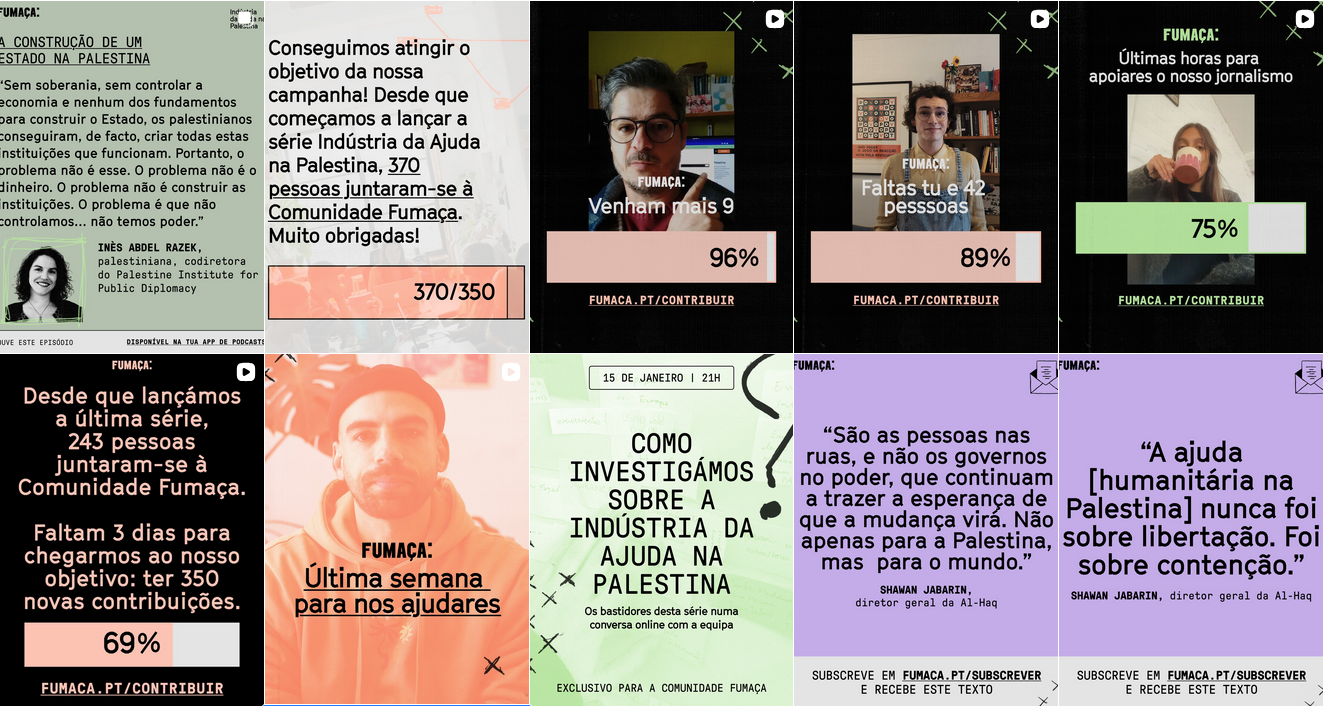
To achieve this goal and secure financial independence, Fumaça runs one to two membership campaigns each year. One of these campaigns started in December 2025, aiming to gain a total of 350 new members by January 16, 2026. In the early stages, the campaign progressed more slowly than expected. The reach of social media content remained limited, partly due to a shadowban. While the accompanying email campaign performed well, it was initially not enough to reach the target.
Over time, new memberships increased, content was shared more widely, and the campaign goal was eventually exceeded. In total, Fumaça gained 370 new members and can now cover 50% of its expenses through recurring contributions.
Maria Almeida, journalist and co-founder of Fumaça, explains how the campaign ultimately became successful and what lessons the editorial team took from it.
***
### **1. A clear goal with a deadline.**
Every campaign at Fumaça starts with a clear number. What matters most isn’t the metric itself, but that it is specific, public, and tied to a deadline. A long-term vision is important, but a set date creates urgency—it signals to the community: now, not later. This sense of urgency proved crucial in the final days of the campaign.
Throughout the campaign, Fumaça regularly updated their progress on the website using a percentage bar and the number of new members. This made the goal visible and tangible. Keeping the messaging simple until the end also helped: “X days left, Y members to go.”
***
### **2. One message to hold everything together**
For Fumaça, every campaign needs a message that the team believes in and feels confident repeating. It has to be truthful, but also meaningful enough to get people excited to help make it real. In this case, it was clear.
As the team was publishing a new podcast series on the aid industry in Palestine, they decided to connect the campaign to that work.
The message was simple and direct: *“We’ve been reporting on the occupation of Palestine for nearly a decade. By joining the community, you help us keep doing this work.”*
***
### 3. Sending a lot of emails (yes, really)
Convincing a newsroom full of journalists to send emails that don’t have direct journalistic content took time. But once Fumaça reached a consensus and tried it, the results were clear: more emails meant more members.
That said, this doesn’t mean sending emails constantly. Fumaça avoids normalizing urgency or pushing people to unsubscribe. They limit these appeals to one or two campaigns per year and rarely ask for money outside of these periods.
For this campaign, Fumaça sent 16 emails over six weeks, with a higher frequency toward the end. In the final five days alone, five emails were sent—and each one generated an immediate response: new members, replies, and messages of support.
***
### 4. Making it a collective effort
At Fumaça, a small team of three journalists may plan the overall strategy, but the campaign only succeeds when the entire newsroom gets involved.
Journalists reached out directly to the audience, explaining why their work matters and how membership makes it possible —whether it was reporting from Palestine, having the time to investigate, or simply being able to practice journalism properly. This was done both through emails and [short social media videos](https://www.instagram.com/reels/DS5Ngv8AGDm/).
About half of the emails were personal and reflective, while the rest were short, direct, and to the point. Every message ended with a clear call to action.
The videos followed the same approach: short, personal, and approachable. Keeping the message positive and engaging also proved effective.
***
### 5. Being transparent (and vulnerable)
Fumaça found that people respond when journalists speak in their own voice — honestly, and sometimes uncomfortably so.
When the work is challenging, the team says so. When finances are tight, they share that as well. If a campaign is progressing more slowly than expected, that’s communicated too. And when goals are reached, the success is celebrated with all those who made it possible. This openness helps people feel involved and part of the work being built. It only works because it’s grounded in trust and authenticity.
***
### 6. Playing the long game
Most people who join Fumaça during a campaign have already thought about it. They’ve hovered over the button, opened the page, got distracted, closed the tab, or told themselves they’d return later.
Rarely does someone decide to support journalism the first time they encounter it. They need reminders that today could be the day.
This is especially true in a media ecosystem built around fragmented attention. Much of Fumaça’s journalism is consumed on third-party platforms rather than the website. That means people can listen to hours of content without ever visiting a page where joining the community feels like the natural next step.
Email helps bridge that gap.
Even though Fumaça only asks for financial support during campaigns, the team works toward these moments year-round. Outside of fundraising periods, the goal is simple: bring people closer by encouraging them to subscribe to newsletters and join the email list.
Currently, over 13,000 people are subscribed. With the campaign finished, the focus shifts back to growing that list — knowing that the next campaign starts long before it’s officially announced.
***
### 7. And, above all, doing good journalism
All of these strategies matter, but they’re not the main reason people support Fumaça.
Around 2,000 members contribute because they believe the journalism itself is worth sustaining. While the team continues to learn how to run better campaigns, the priority remains unchanged: well-researched, carefully edited, and immersive investigative audio journalism.
{% hint style="success" %}
**Want to know how to create a successful campaign email?** Check out these [tips from CORRECTIV](/community-journalismus/english/community-centred-methods/how-donation-campaigns-work-at-correctiv/how-to-structure-a-donation-email.md). The advice and example email come from a fundraising campaign, but they can just as easily be applied to a membership campaign.
{% endhint %}
***
---
# Agent Instructions
This documentation is published with GitBook. GitBook is the documentation platform designed so that both humans and AI agents can read, navigate, and reason over technical content effectively. Learn more at gitbook.com.
## Querying This Documentation
If you need additional information that is not directly available in this page, you can query the documentation by asking a question.
Perform an HTTP GET request on the following URL with the `ask` and `goal` query parameters:
```
GET https://wiki.beabee.io/community-journalismus/english/community-centred-methods/tips-for-successful-membership-campaigns-from-fumaca.md?ask=&goal=
```
`ask` is the immediate question: it should be specific, self-contained, and written in natural language.
`goal` is what the user is ultimately trying to achieve, the reason they need the answer. Sharing it helps GitBook give you a better, more relevant answer. A goal is most helpful when it describes the outcome the user wants rather than restating the question. For example, with `ask=how do I create an API token`, a goal like `automate deployments from our CI pipeline` lets GitBook tailor the answer to that use case.
The response will contain a direct answer to the question and relevant excerpts and sources from the documentation.
Use this mechanism when the answer is not explicitly present in the current page, you need clarification or additional context, or you want to retrieve related documentation sections.