> For the complete documentation index, see [llms.txt](https://wiki.beabee.io/community-journalismus/llms.txt). Markdown versions of documentation pages are available by appending `.md` to page URLs; this page is available as [Markdown](https://wiki.beabee.io/community-journalismus/english/basics-community-journalism/the-essentials-of-community-engagement.md).
# The Essentials of Community Engagement
Involving your community is at the heart of every community-centered organization. But what does engagement really mean? And how do engagement processes work? You’ll find the answers in this article.
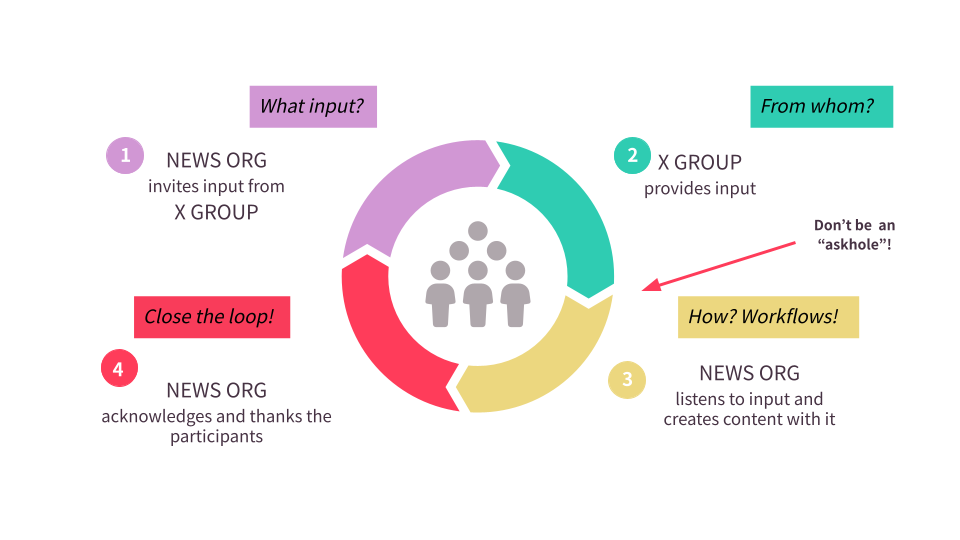
Engagement happens when you actively interact with the people you serve: they respond to your content, questions, and contributions, and you respond to their feedback in return. It’s a **two-way process** where both sides benefit – a continuous cycle of exchange and dialogue, much like any relationship. [Hearken](https://wearehearken.com/) illustrates this cycle with its “Engagement Ring.”
Source: Hearken
In the first step, the editorial team **asks for input** and gives people the opportunity to participate – for example, through a survey, an invitation to a conversation, an event, or participation in a decision-making process or collaborative project. Especially if you are involving your community for the first time, low-threshold participation formats like surveys are a good starting point. They allow you to ask specific questions, create specific opportunities for engagement, and enable participants to share their opinions, ideas, or suggestions with just a few clicks.
Once you’ve invited people to participate, your **target audience responds** to the call and provides input – this can include feedback, opinions, topic suggestions, or ideas.
Next comes the crucial third step, which is often overlooked: **capturing input, understanding it, and turning it into content. Don’t be an askhole!** Good engagement begins when participants can see the impact of their input and what comes from it. If you invite people to participate but nothing happens afterward – for example, due to lack of time or a change of plans – you undermine the process and risk losing the trust that was built through genuine listening. Moreover, your community’s willingness to participate next time will likely decrease. It is therefore essential: anyone who invites participation must also listen. Respect the time participants have invested – regardless of how many people were involved. Take their input seriously and respond to it.
At the end, make sure to **address participants explicitly** – ideally, you’ve collected email addresses or other contact information. Thank them personally, for example with an email, and publicly acknowledge their contributions to make participants visible. When publishing content that arose from community input, always be transparent about the source. Input may influence your actions, but participants won’t know it unless you communicate clearly. **Communication throughout the engagement process is key**. It shows people that their contributions truly matter. This builds trust in your organization and motivates them to participate in future initiatives. Even those who only followed the first engagement passively can be encouraged to get involved next time through consistent communication. Take your community along every step of the way: thank them for participating and show transparently what happened with their input.
{% hint style="info" %}
This is precisely why **contact information** is the **cornerstone of your engagement strategy**. Whenever possible, you should always collect contact details during the engagement process. Only by creating direct points of contact can you build a long-term relationship and close the cycle of participation.
{% endhint %}
Once you’ve completed the cycle, you can start the **next engagement method**, invite your community to participate again, gather new input, and listen attentively to your audience. Engagement is an ongoing, reciprocal process – a conversation with your community that ideally never ends.
***
---
# Agent Instructions
This documentation is published with GitBook. GitBook is the documentation platform designed so that both humans and AI agents can read, navigate, and reason over technical content effectively. Learn more at gitbook.com.
## Querying This Documentation
If you need additional information that is not directly available in this page, you can query the documentation by asking a question.
Perform an HTTP GET request on the following URL with the `ask` and `goal` query parameters:
```
GET https://wiki.beabee.io/community-journalismus/english/basics-community-journalism/the-essentials-of-community-engagement.md?ask=&goal=
```
`ask` is the immediate question: it should be specific, self-contained, and written in natural language.
`goal` is what the user is ultimately trying to achieve, the reason they need the answer. Sharing it helps GitBook give you a better, more relevant answer. A goal is most helpful when it describes the outcome the user wants rather than restating the question. For example, with `ask=how do I create an API token`, a goal like `automate deployments from our CI pipeline` lets GitBook tailor the answer to that use case.
The response will contain a direct answer to the question and relevant excerpts and sources from the documentation.
Use this mechanism when the answer is not explicitly present in the current page, you need clarification or additional context, or you want to retrieve related documentation sections.